

Risk-Reducing Mastectomy in Young Women: Myths, Benefits, and Limits
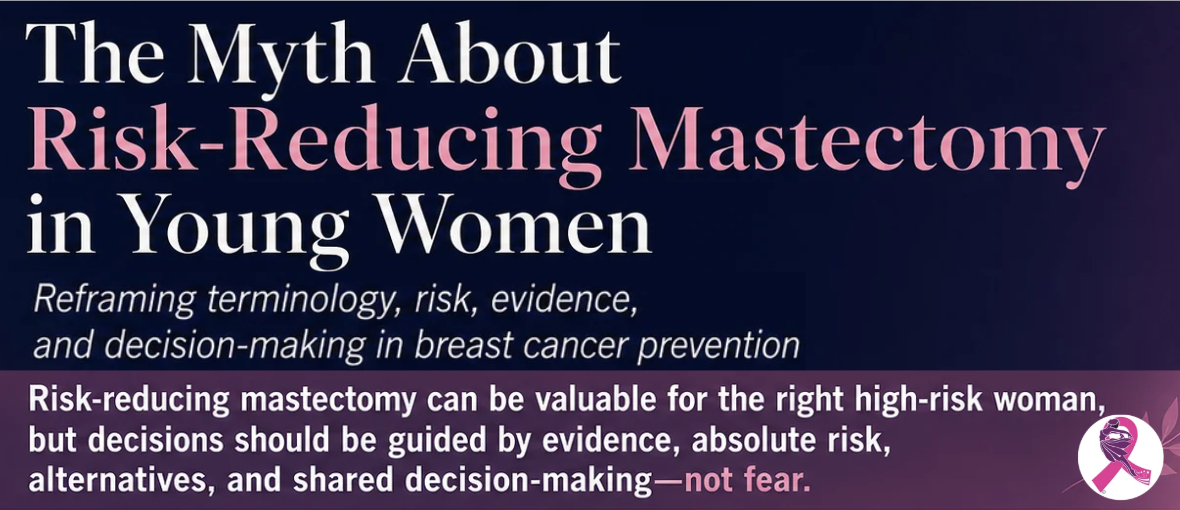
Breaking The Myths About Risk-Reducing Mastectomy.
Myths About Preventive Mastectomy.

Risk-Reducing Mastectomy.
BCYW Foundation explains why preventive breast surgery should be guided by genetics, individualized risk, shared decision-making, and realistic expectations.
DENVER, CO, UNITED STATES, July 9, 2026 /EINPresswire.com/ -- To address the gaps in breast health awareness, the Breast Cancer in Young Women Foundation (BCYW Foundation) has released a new awareness article by experts addressing one of the most emotionally charged and frequently misunderstood decisions in breast cancer prevention: risk-reducing mastectomy in young women.The article, “The Myth About Risk-Reducing Mastectomy in Young Women,” by Rakesh Kumar, PhD, Caroline Drukker, MD, PhD, and Marie-Jeanne T. F. D. Vrancken Peeters, MD, PhD, reframes common beliefs about preventive breast surgery and clarifies why risk-reducing mastectomy shouldn't be seen as a universal safety measure, a guarantee against breast cancer, or a general precaution for most young women.
A POWERFUL OPTION — BUT NOT A UNIVERSAL ANSWER
Risk-reducing mastectomy can significantly decrease the risk of breast cancer, particularly for women with a very high inherited risk, such as carriers of pathogenic variants in genes like BRCA1, BRCA2, TP53, PALB2, CDH1, and other high-risk syndromes. For these women, surgery may be a key part of a comprehensive prevention and surveillance plan.
However, the article highlights that calling it “preventive mastectomy” can be misleading, since even the most thorough procedure cannot eliminate all breast epithelial cells. Consequently, some breast tissue may remain, leaving a small ongoing risk of breast cancer. The article advocates for using the more precise term “risk-reducing mastectomy.”
WHY THE MYTH MATTERS
The Foundation notes that many young women may overestimate their personal risk or see risk-reducing surgery as complete protection. Some might view surgery as a way to find certainty when facing fear, uncertainty, or concerns about family history.
Nonetheless, for most young women without high-risk inherited mutations or a strong family history, the benefits and harms can vary significantly. Major surgery, especially with reconstruction, impacts physical, emotional, psychological, and long-term quality of life.
MORE SURGERY DOES NOT ALWAYS MEAN BETTER SURVIVAL
The article also highlights the growing trend of contralateral prophylactic mastectomy among women diagnosed with cancer in one breast. While removing the healthy breast can decrease the risk of developing a second primary breast cancer, it does not necessarily improve overall survival for most women with unilateral breast cancer.
This distinction is important for awareness: lowering a specific future risk does not always translate into a survival advantage. When choosing surgery, it’s essential to consider factors such as modern systemic therapies, tumor biology, recurrence risk, and the likelihood of metastasis.
THE OVERLOOKED BURDEN OF PAIN AND RECOVERY
The article also dispels the misconception that pain after mastectomy and reconstruction is always temporary or merely part of the healing process. Post-mastectomy pain syndrome can persist for months or even years, leading to symptoms such as numbness, burning sensations, stabbing pain, or hypersensitivity in the chest wall, armpit, or upper arm.
Importantly, younger women may also face a higher risk of chronic pain, as some studies indicate that younger age could be associated with increased chances of persistent post-surgical pain. Recognizing this risk enables patients to seek earlier referrals for pain management, physical therapy, rehabilitation, and psychological support.
TOWARD PRECISION PREVENTION
The Foundation advocates a precise approach to breast cancer prevention in young women, emphasizing the need to tailor interventions to actual risk levels rather than to fear, assumptions, or incomplete data.
Discussions regarding risk-reducing mastectomy should include genetic counseling, personalized risk evaluations, family history, alternative monitoring methods such as MRI and mammography, surgical options, reconstruction possibilities, potential complications, residual risk, and considerations of body image, sexuality, sensation, pain, recovery, and long-term quality of life.
A BREAST HEALTH MESSAGE FOR YOUNG WOMEN
Risk-reducing mastectomy can be transformative and suitable for some women; however, it is not a universal solution for everyone seeking reassurance.
The BCYW Foundation encourages young women to pursue evidence-based counseling before making permanent surgical choices. The aim is not to deter surgery when appropriate, but to ensure that major preventive procedures are selected for the right reasons, by suitable candidates, and with a full understanding of the benefits, limitations, and long-term effects.
A THOUGHT TO CARRY
More intervention is not always better. Better-matched intervention is more effective.
Risk-reducing mastectomy should be seen as a targeted approach for women at very high risk, rather than a guarantee, a universal precaution, or the sole method of breast cancer prevention.
FOR FULL DETAILS, readers are encouraged to read the article on LinkedIn.
“The Myth About Risk-Reducing Mastectomy in Young Women: Reframing terminology, risk, evidence, and decision-making in breast cancer prevention” by Rakesh Kumar, PhD, Caroline Drukker, MD, PhD, and Marie-Jeanne T. F. D. Vrancken Peeters, MD, PhD.
https://www.linkedin.com/pulse/myth-risk-reducing-mastectomy-young-hgpzc/
ABOUT THE BCYW FOUNDATION
The Breast Cancer in Young Women Foundation (BCYW Foundation) is a U.S.-based nonprofit public charity organization dedicated to breast cancer in young women. The BCYW Foundation brings together a diverse network of scientists, oncologists, surgeons, survivors, NGOs, and partners from 35 countries. The foundation is advancing its targeted awareness and research efforts and highlighting emerging advances in BCYW through its peer-reviewed, open-access Journal of Young Women's Breast Cancer and Health. More recently, the BCYW Foundation has established the Young Women’s Breast Cancer Research Institute (YWBCRI) to advance research on the early biology, detection, interruption, and prevention of breast cancer in young women. Through evidence-based analysis, the Foundation works to improve outcomes and long-term survivorship horizons for young women diagnosed with breast cancer.
DISCLAIMER: This information is for educational purposes only and is not a substitute for professional medical advice. Please consult a doctor for any concerns or questions.
Rakesh Kumar, Ph.D., Founder and CEO
Breast Cancer in Young Women Foundation
+1 303-900-8066
bcywf@breastcancerinyoungwomen.org
Visit us on social media:
LinkedIn
Bluesky
Instagram
Facebook
YouTube
X
Legal Disclaimer:
EIN Presswire provides this news content "as is" without warranty of any kind. We do not accept any responsibility or liability for the accuracy, content, images, videos, licenses, completeness, legality, or reliability of the information contained in this article. If you have any complaints or copyright issues related to this article, kindly contact the author above.
